
Hello, everyone, who seeks fascinating stories at the intersection of technology and future society! Today, I'm here to share shocking news that goes beyond simple scientific and technological updates, potentially shaking our ethical views and the very nature of future warfare. This news concerns Russia's development of so-called 'cyborg pigeon drones,' which involve implanting chips into the brains of live pigeons for remote control.
This news is not merely a tale from science fiction. This project, already underway in reality, not only fundamentally alters our perception of the familiar pigeon but also simultaneously reveals both the bright and dark sides that advanced technology can bring. We need to deeply explore how far this technology can advance, what ethical issues it might raise, and what questions it poses for our future society.
The Emergence of 'Cyborg Pigeons': Technological Shock and Reality
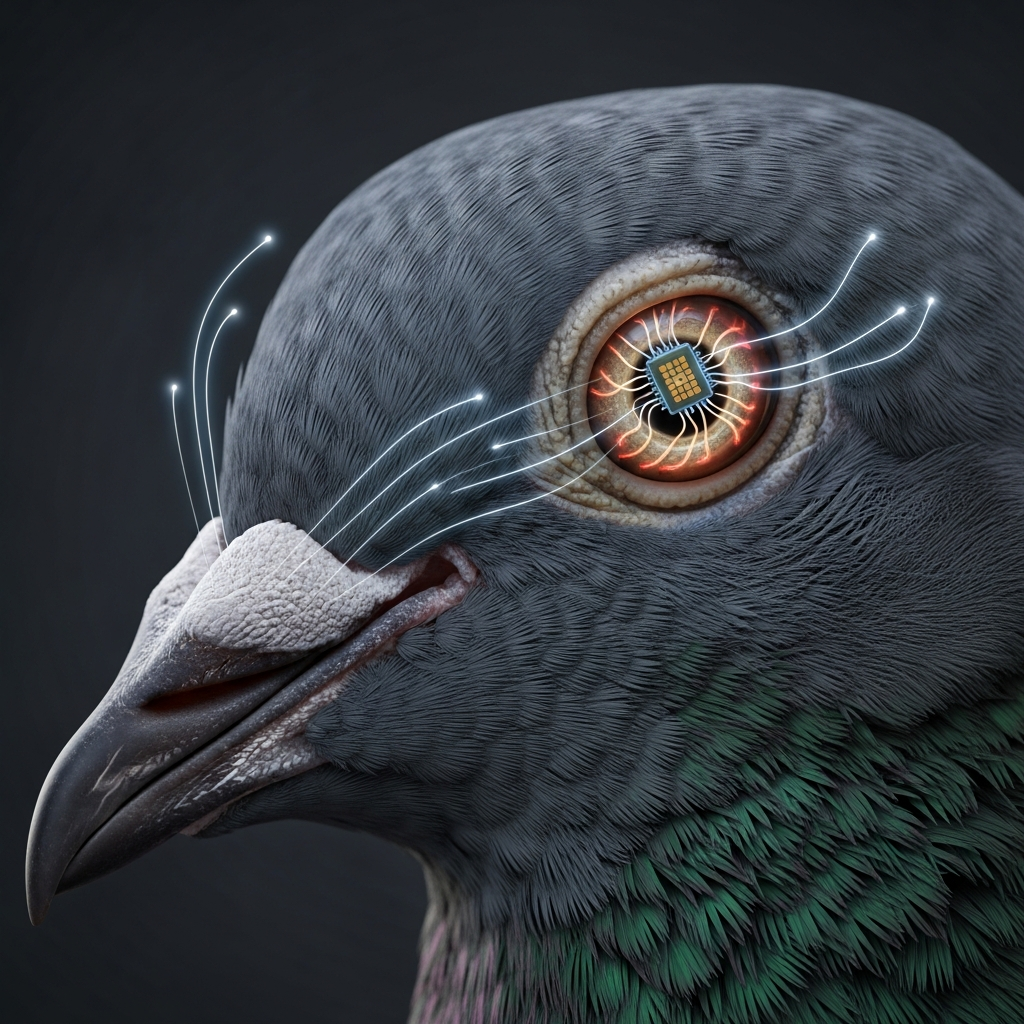 Neural chip implanted in a pigeon's brain and remote control signals
According to recent reports, a Russian neurotechnology company is developing 'cyborg pigeon drones' that remotely control live pigeons. This news has sent shockwaves worldwide, sparking both astonishment at technological advancement and profound concern.
 A pigeon naturally blending into an urban environment, observing its surroundings
Russia: Neiry Group's PJN-1 Project
According to foreign media reports, including the British daily The Telegraph, Russia's nascent neurotechnology company 'Neiry Group' is developing technology to remotely control pigeons by implanting neural chips in their brains through a project named 'PJN-1'. The core of this technology involves implanting tiny chips into the pigeons' skulls to manipulate brain signals, thereby remotely controlling their flight direction and behavior. It's as if a story straight out of a sci-fi movie is becoming a reality. These 'pigeon drones' are reportedly intended for use in warfare or surveillance, possessing the potential to overcome the limitations of conventional mechanical drones. For instance, while mechanical drones can be easily detected by their distinct noise or heat signatures, pigeon drones, with their natural appearance, could be far more effective at deceiving the enemy.
Pigeons: Why Pigeons, of All Birds?
Among countless bird species, why were pigeons chosen? There are several scientific and strategic reasons. First, pigeons have historically been utilized as 'symbols of peace' and 'messengers' due to their excellent homing instincts and long-distance flight capabilities. They have a historical background of delivering crucial messages on battlefields from ancient times to the modern era. Second, pigeons are accustomed to urban environments and are not typically viewed with suspicion, even when noticed by people. As a common bird like sparrows or brown-eared bulbuls, they offer natural camouflage for surveillance or espionage activities. In stark contrast to recent appearances of 'doves of peace' performing spectacular displays at events like Seoul Fashion Week or Olympic opening ceremonies, the fact that pigeons could now transform into 'eyes of surveillance' is both ironic and chilling. Third, pigeons are relatively small and light, making them difficult for radar to detect, and their energy efficiency is higher than mechanical drones, which could be advantageous for long-duration missions. These biological and behavioral characteristics appear to be the core motivations behind the 'cyborg pigeon' project.
The Dual Nature of Technology: Between Hope and Concern
While 'cyborg pigeon' technology presents new possibilities for humanity, it simultaneously brings serious ethical and social issues to the forefront. It is crucial to deeply understand the dual nature of technological advancement.
Military Applications: From Espionage to Bioweapons
Russia's 'cyborg pigeons' are highly likely to be used for military purposes. The most immediate concern is their potential for espionage and surveillance activities. They could infiltrate deep into enemy territory to collect various information, such as taking photographs, recording audio, and detecting wireless signals. For instance, they might enter buildings through crevices or windows, or be used to tail specific individuals. A significant advantage is their ability to operate more discreetly and naturally disguised than conventional drones, making detection difficult. However, an even more serious concern is the potential misuse of these 'pigeon drones' as bioweapon delivery systems. Scenarios involving the dispersal of deadly viruses or toxic substances in small containers over specific areas cannot be ruled out. This possesses the potential for weapons of mass destruction and could lead to uncontrollable consequences, thus prompting strong warnings from the international community.
Ethical Dilemmas and International Legal Issues
The act of implanting chips into the brains of live animals to control them raises severe ethical concerns. It inevitably draws criticism for infringing upon animal rights, inflicting suffering, and forcibly controlling natural behaviors. We are confronted with the fundamental question: should we treat animals merely as tools or weapons? If this technology spreads, it could be applied to other animals, potentially eroding the ethical boundary against 'weaponizing living beings'. Furthermore, the military use of 'cyborg pigeons' introduces complex issues under international law. Should these bio-mechanical hybrids be considered weapons? If so, what international conventions or regulations would apply? Existing agreements like the Chemical Weapons Convention or the Biological Weapons Convention do not provide clear standards for such novel technologies. The reality that technological advancement far outpaces the speed of legal and ethical discourse presents humanity with a new challenge.
Questions for Future Society
Beyond mere technological development, 'cyborg pigeons' raise profound questions about the future society we will inhabit and humanity's responsibilities. It is time to consider how the direction of technological advancement and our values should harmonize.
Technological Advancement and Human Responsibility
Neuroscience and biotechnology, including brain-computer interfaces (BCI) and gene-editing technologies, are advancing at an astonishing pace. 'Cyborg pigeons' represent one facet of this technological progress, posing fundamental questions about how far humanity should advance technology and how it should be controlled. While technology can enrich human lives and contribute to curing diseases, it can also be misused for destructive purposes. We must recognize the importance of 'responsible innovation' in technological development. Scientists, policymakers, and the general public must all actively participate in anticipating the potential impacts of such technologies and in establishing ethical guidelines and regulatory frameworks. Similar to discussions on AI ethics or gene-editing technology, robust debate and consensus are needed for bio-mechanical fusion technologies. Otherwise, technology could become an uncontrollable monster, threatening humanity.
From 'Symbol of Peace' to 'Eye of Surveillance': The Changing Meaning of Pigeons
Pigeons have long been regarded as symbols of peace, hope, and freedom. As seen with Charlize Theron's appearance in a 'dove of peace' performance at a recent Olympic opening ceremony, which garnered acclaim, pigeons still carry a positive image. However, the emergence of 'cyborg pigeons' is fundamentally shaking these traditional meanings. Concerns are growing that pigeons could now become symbols not of peace, but of surveillance, control, and potential threat. This goes beyond a mere change in the meaning of a living creature like the pigeon; it prompts humanity to reflect once more on its attitude and perception of nature and life itself. We must question whether it is truly the right path to defy the laws of nature and instrumentalize life in the name of technology. Like the stories of people who move to Ilsan and feel the wonder of nature while observing various birds, nature is a being that offers us peace and beauty. Can technology that destroys and transforms such nature truly be called progress for humanity?
Conclusion
The news of Russia's 'cyborg pigeon' development presents us with both the astonishing possibilities that advanced technology can bring and serious ethical and social issues. This technology holds the potential for misuse in military espionage and as a weapon delivery system, sparking ethical controversies such as the infringement of animal rights. We must confront the dual nature of technological advancement and deeply consider how humanity can utilize technology responsibly while upholding the value of respect for life.
These discussions are not solely the responsibility of scientists or policymakers. All of us must take an interest in the development of such technologies and actively participate in the process of establishing ethical standards and social consensus. The answer to what kind of world we will bequeath to future generations depends on the choices we make right now.
이 포스팅은 쿠팡 파트너스 활동의 일환으로, 이에 따른 일정액의 수수료를 제공받습니다.